AI-supported finite element analysis in vehicle development: Potentials and areas of application
AI in finite element analysis as an accelerator of vehicle development
Artificial intelligence is becoming increasingly important in product and vehicle development – especially in simulation.
Finite element analysis (FEA) is a key tool for calculating:
Tensions
Deformations
Structural behavior under load
👉 AI expands these methods by automating, optimizing, and accelerating processes.
Use of AI in simulation
AI methods are particularly helpful in:
Feature extraction from CAD models
Definition of boundary conditions and load cases
Modeling and idealization decisions
Among other things, the following are used:
Parameter optimization (e.g., SMAC)
Clustering approaches
genetic algorithms
👉 The goal is to make complex simulation processes more efficient and robust.

Finite element analysis 
Finite element analysis 
Finite element analysis 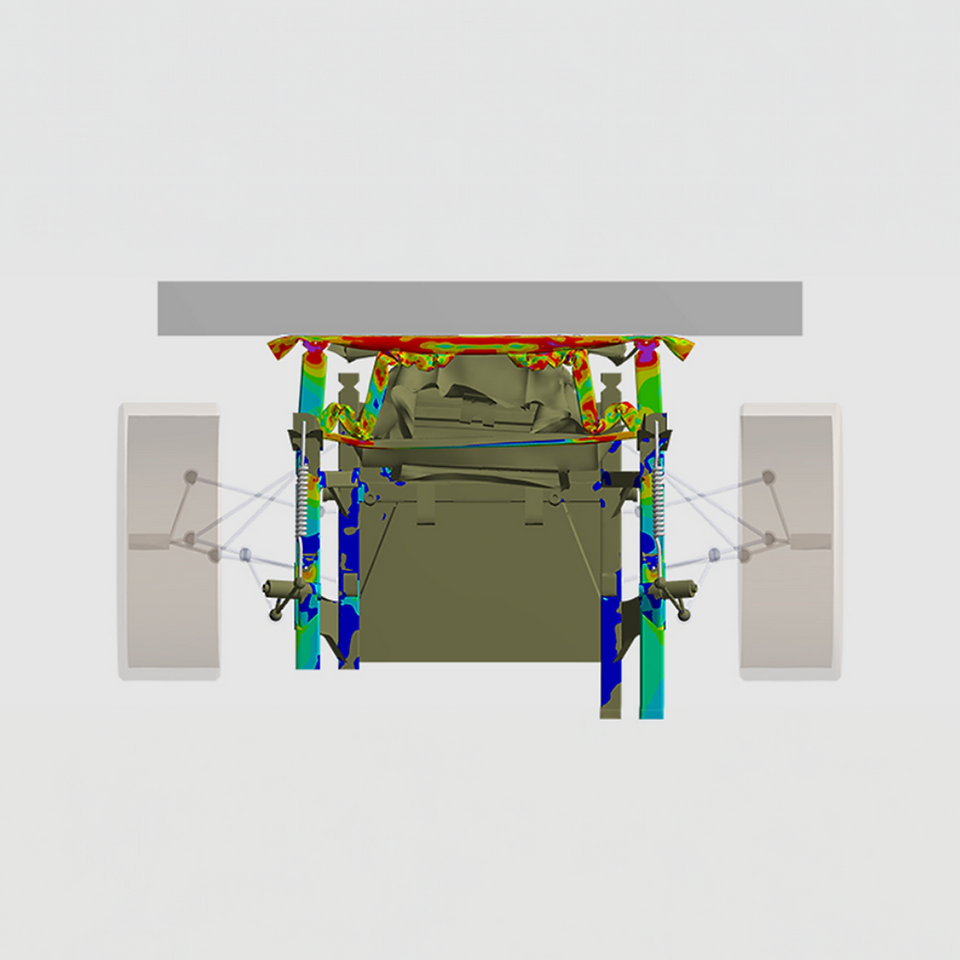
Crash simulation chassis 
Finite element analysis 
Finite element analysis 
Finite element analysis of a rim
Specific advantages in vehicle development
Optimization of designs
AI makes it possible to evaluate variants more quickly and to identify optimized structures – especially in the interplay between strength and lightweight construction.
Automation of simulation processes
The generation of FE models, load definitions and simulations can be partially automated.
👉 Result:
shorter development times
more efficient resource use
Material and structure optimization
By analyzing large amounts of data, AI identifies relationships between:
Material properties
geometry
Burden
👉 This supports the selection of suitable materials and structures.
Faster analysis of large data sets
Simulations generate enormous amounts of data.
AI helps with this:
Recognizing patterns
to identify critical areas more quickly
to reduce evaluation times
Lifetime predictions
Data-driven models allow us to:
Fatigue effects
potential failure points
detect early.
Topology optimization
AI helps in the development of weight-optimized structures that can simultaneously withstand high loads.
👉 Particularly relevant for lightweight construction and efficient vehicle architectures.

Limits and classification of AI in simulation
Despite all its potential, AI does not replace engineering expertise.
👉 The crucial point remains:
the correct model building
the interpretation of the results
the security provided by experience
AI is therefore a tool – not a replacement for engineering expertise.
Our approach: a combination of simulation, experience, and AI
For us, AI is a complementary tool within an established development process.
We connect:
classic CAE methods
AI-supported optimization approaches
practical experience from real projects
👉 The goal is to achieve robust and durable results – not just fast ones.
Validated simulation as a basis for real-world applications
A crucial factor is the transferability of the simulation results into practice.
As an FIA-certified calculation partner for safety structures, we have extensive experience in safeguarding components and systems.
Our services include, among other things:
CAD preparation
Modal analysis
harmonic and random vibration analyses
linear and nonlinear structural analyses
Topology optimization
Crash and explicit simulations
Analysis of composite materials
👉 This ensures that simulation results are reliable even under real-world conditions.
AI as part of future development processes
The integration of AI into simulation processes will continue to increase.
However, the crucial factor will be to meaningfully integrate AI into existing development processes – and not to consider it in isolation.


Comments