Aerodynamic vehicle components: Development and integration of rear wings
Aerodynamic vehicle components and their function in the overall system
Aerodynamic vehicle components such as rear wings are far more than just visual elements.
They have a significant influence on:
Down pressure and driving stability
Driving behavior at high speeds
Overall vehicle balance
However, their effect only occurs when they are precisely integrated into the vehicle concept.
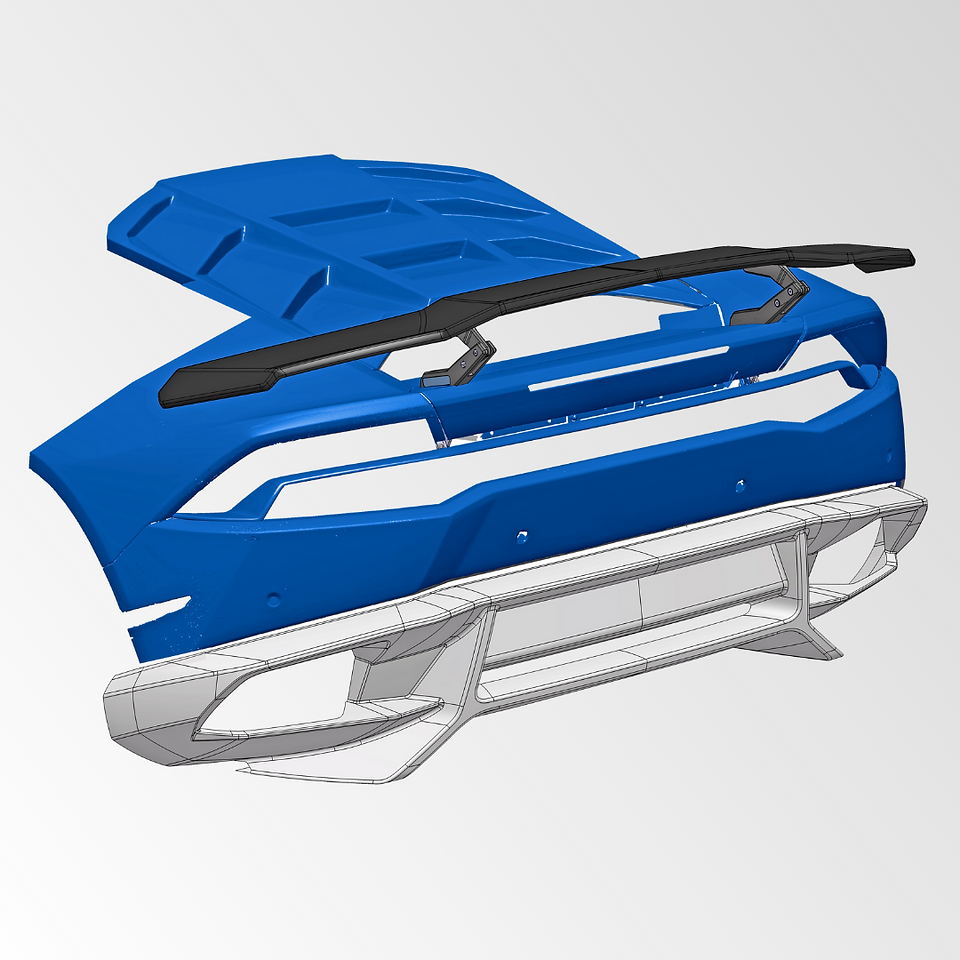
Lambo rear wing development


Influence of geometry and adjustability
A crucial factor is the design of the geometry.
Height-adjustable or adaptable systems allow for targeted modification of the vehicle setup – depending on:
speed
Track layout
Operating conditions
A lack of coordination often leads to aerodynamic components not reaching their full potential or even producing negative effects.
Development of aerodynamic assemblies
The development of such components follows a clearly structured process:
Capturing the construction space (e.g. via 3D scan)
Design and integration into the vehicle environment
Simulation and strength analysis (FEM) – evaluation of load cases and operating conditions
👉 The goal is to develop a component assembly that is functional, durable, and integrable.
Simulation and verification
Besides interpretation, validation plays a central role.
This includes:
structural strength verifications
Assessment of aerodynamic loads
Technical documentation support
Preparation for inspections by technical services
👉 Especially with components relevant for approval, clear documentation is crucial.
Implementation from design to finished component
Besides development, practical implementation is an essential component.
This includes:
Tool design
Coordination of manufacturing processes
Production of components and assemblies
Integration into the vehicle
👉 This shows whether a design also works under real-world conditions.
Our approach: Aerodynamic components as an integrated assembly
For us, a rear wing is not a single component, but part of an overall architecture.
The interplay with the following is crucial:
Body structure
Vehicle balance
overall aerodynamic concept
We combine development, simulation and implementation into a seamless solution.
This results in components that are not only visually appealing, but also functionally and technically convincing.


Comments